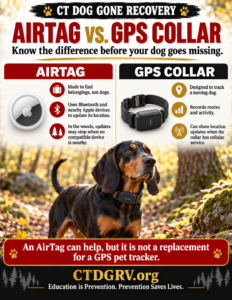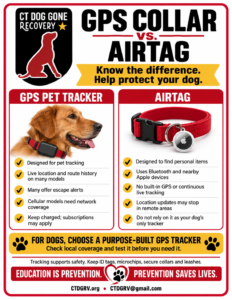
Apple AirTag VS GPS
Apple Air Tag vs GPS Collar for your Dog:
Putting an Apple AirTag on a dog collar is something so many of us do for a little extra peace of mind. It is small, inexpensive, skips the annoying monthly subscription, and sits right there next to your other apps.
We all like to think our dogs are little angels who would never bolt toward a road, but just in case, we slap a luggage tracker on them and call it a day. After all, if it can track a misplaced wallet at brunch, surely it can handle a terrified dog booking it through the brush.
Right? Well, not quite.
I’ve used a GPS collar for my dog Atlas for years now, and honestly, it’s a game changer. It gives me peace of mind and fun activity data, but it has also bailed us out of a couple of tight spots. Like the time a fern looked suspiciously like an apex predator that needed to be taught a lesson, causing Atlas to sprint fifty yards away into a wooded area. Without a real tracker, that five minute panic would have felt like five hours.
The reality is that an AirTag was built to find keys left at a coffee shop, not a panicked dog moving at a full sprint through a patch of woods. Knowing the difference between the two can completely change the outcome if your dog ever decides to go exploring on their
own.
1. How They Actually Work
AirTags rely entirely on proximity. An AirTag does not actually have built in GPS. Instead, it uses Bluetooth to bounce a signal off any nearby Apple device just to update its location.
If your dog bolts into a wooded park, a quiet neighborhood, or anywhere else where people are not constantly walking around with an iPhone in their pocket, your AirTag goes completely dark. You cannot track a signal that has nobody to talk to.
GPS collars are built for the job. A proper pet tracker connects directly to satellites and cellular networks to stream real time location updates straight to your phone, regardless of whether you are in a crowded downtown or out on a quiet trail. They even record your dog’s routes and daily activity.
2. The Distance Factor
AirTags are designed for close range. If your dog is hiding under the back deck or locked inside a neighbor’s shed, an AirTag is fantastic. Once they start moving fast or get more than a hundred feet away from a compatible phone, you are effectively flying blind (which is usually about the exact moment your blood pressure hits maximum capacity).
GPS collars give you the whole picture. They record routes, track live movement, and let you follow a fleeing dog across actual miles instead of hoping a stranger happens to walk past them.
The Bottom Line
An AirTag is great for finding your keys, and it can certainly help in a pinch if your dog is wandering right around the house. But as the saying goes, an AirTag can help, but it is not a replacement for a GPS pet tracker. When a dog goes into survival mode and covers a lot of ground in a hurry, you need a tool built to keep up.
Education is prevention, and prevention saves lives.